Launch of the Drakensburg Experience Route – 29 August at Estcourt in KZN-Natal. See the details of this event, which we wish you could attend, at http://afrikatourism.blogspot.com With 108 to start with this route has more participants than any other Open Africa has developed so far. We can provide road transport from Johannesburg for anyone interested in attending the launch.
Open Africa history year by year. Sometimes it is good to reflect:
1990 - The idea is mooted, premised on the belief that, after politics, job creation was going to become this country’s greatest imperative.
1991 - The seed germinates with Engen agreeing to fund an investigation into its implications.
1992 - Turning conservation into an industry via tourism is the theme.
1993 - A keynote address delivered at a conference between scientists and industrialists leads to the assembly of a think-tank of eminent people to debate the idea.
1994 - ‘Linking the splendours of Africa in a network of routes’ is adopted as the vision and the president of the World Travel and Tourism Council joins the group.
1995 - Open Africa is officially registered as an NGO.
1996 - The footprint logo is devised, based on the fossil evidence discovered at Langebaan of a human footprint that proves Africa’s status as the birthplace of humankind.
1997 - President Nelson Mandela becomes Open Africa’s patron and Open Africa is the catalyst in the formation of the Peace Parks Foundation.
1998 - A vastly ambitious Web innovation is embarked upon, which results in the world’s first GIS integrated website.
1999 - The first route is developed, the Southern Overberg Fynbos Route.
2000 - By the end of this year 13 routes have been developed.
2001 - The first route outside SA is developed, on the Ilha de Mocambique.
2002 - There are 34 routes by the end of this year.
2003 - Credibility is being earned, but with it the realisation that the need for aftercare is more crucial than anticipated.
2004 - The World Tourism Organisation cites the Open Africa methodology as a best practise example in China.
2005 - Routes developing faster now, allowing for networking benefits to start taking effect, but with it experience is accumulated of the pitfalls in achieving sustainability.
2006 - The first route networker appointed, to focus specifically on aftercare.
2007 - The 50 route mark is passed and serious re-investment of knowledge gained into existing routes commences.
2008 - Now with routes in six countries, involving nearly 2000 participants who together employ more than 20 000 people, the network is becoming a plug-in tourism switchboard for marginalised and rural communities.
Buying a second-hand 4X4 should not be cause for much excitement but here it is a really big deal. We need this vehicle that arrived last week for the about to commence development of nine new biodiversity focused routes in rural areas in Namibia and Zambia. Designed to be all of an office on wheels, kitchen, dispensary, and accommodation, had it brains this mechanical object will probably have done all in its power to avoid our attention. To be based in Livingstone for the next two years, what it saves on accommodation whilst travelling will just about cover its cost.
After a countrywide search for the right thing, the vehicle in question was found at a dealer near Leesk Street in Klerksdorp. Leesk was the man who equipped David Livingstone’s wagons for his trek northwards more than 150 years ago – hopefully an auspicious coincidence.
Last week Open Africa held its own Polokwane conference, the first toward establishing a provincial forum for the routes in Limpopo. Attended by more than 30 delegates it opened the way to what promises to be a much higher level of collaboration and significantly improved marketing impacts.
Monday, August 25, 2008
Open Africa Reflection

Fortnightly Open Africa Update
“The pride in her eyes will stay with me forever,” said Route Networker Jolene. She was talking about Gertrude Sonqayi, who operates a homestay on the Mothers of Creation Route, Inspired by the Open Africa mantra that you should be who you are and start with what you’ve got, she entered her name for training as a homestay hostess despite fearing the implications of having to write tests in English. But with determination and some help with translations she passed, and today welcomes guests with her husband to her Siyabonga homestay, where, again in Jolene’s words, you find yourself amongst beautiful people.
We make a big thing about being who you are at Open Africa. Not only to boost people’s confidence but also to emphasize the difference between being attractive versus being beautiful. What people do outwardly to be attractive is generally false, whilst what they are inwardly that makes them beautiful is authentic. Authenticity is what travellers rate highest in what they are seeking.
In what has been a typical fortnight at Open Africa, Francois addressed a community meeting at Darling, where they are interested in developing a route, is engaged in planning the Drakensberg launch that takes place this week, is putting the finishing touches on the new website that goes live on September 1, and is working on a Basecamp strategy – if you have not heard of Basecamp we must demonstrate it to you when next we meet. It is an extraordinary piece of Web 2.0 software that considerably facilitates the planning and tracking of projects.
Why I love South Africa
I love her for the perfection of her days
The crisp Karoo morning
The Joburg winter noon
The late summer Cape Town sunset
The star-filled Free State night
I love her for her people
For our warm smiles
For our resilience
For our I-am-because-we-are
I love her because she delights my senses
Highveld thunderbolts
Jacarandas in bloom
Sunday braais
African sun
Icy sea
I love her raw power, her intensity, her strength
I love her because of how she makes me feel
Sometimes angry, sometimes joyous
Sometimes fearful, sometimes love-filled
Sometimes frustrated, sometimes hopeful
Always alive
I love her because she intrigues me
And challenges me
The Chinese have a curse: "May you live in interesting times"
I see it as a blessing
I love her because she helps me keep things in perspective
By reminding me how privileged I am
Every day
I love her for being a microcosm of the world
A world in one country
For what we can teach the world
About compromise
And sharing
And forgiveness
And tolerance
And hope
I love her because she's imperfect
And full of opportunity
And potential unfulfilled
I love her because she has come so far
And has so much further to go
And whether we ever get there
Will all depend on us
I love her because she's been so good to me
And she inspires me to return the favour
I love her because she's my country
No matter what
I love her because she's my home
And where my soul is at rest
By Ian Macdonald
Tuesday, July 15, 2008
Think carefully about this
It can not be denied that every individual pursues the conveniences of physical comforts and conveniences of self-actualization especially when he or she works hard for it.
The pursuit of such objectives, where one is blind to the need of others and deficiency of their surroundings, becomes a hollow pursuit.
The only thing that matters in the end of the day, is been part of a greater common effort to remedy the worlds problems. Gandhi once said: “Be the change, you want to see-in others and the world”
Monday, July 14, 2008
An Epic Journey Starts Here
It is with immense excitement that I share this news - Open Africa got awarded a 3 year World Bank contract to develop 8 new routes ! - 1 in Northern Namibia (Okavango Delta) and 7 crisscrossing Zambia.
The following earnest preparation has started for this epic journey, namely:
- Buying a hardcore vehicle: What better than a 4.2 liter V6 Land Cruiser 70 Station wagon
- Equipped with roof rack, rooftop tent, 4 Jerry Cans, ARB + Winch, gas, spade, high lift jack, 4 ammo case drawer system, Waeco fridge, dual battery system with 12V/220V converter and awning system.
- Research on Zambia and Zambian support organization
 Land Cruiser 70 Station Wagon
 Yes, no computer and DVD screens!
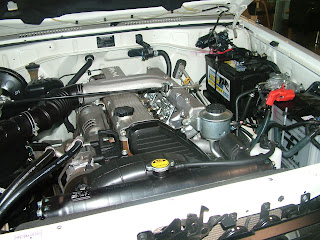 “Horses for Courses” – This one will run on cooking oil
The intention is to keep you posted on every step of my journey over a 3 year period and hopefully convince you to follow suit.
Random Zambian quote of this post: No sweat, no sweet - Taken from "No work, no pay”.
Thursday, June 26, 2008
The Dual Life of Deon Botha, A Digger from Delpoortshoop
 The game is uneventful, so I strike up a conversation with a heavily-built digger. The topic is malaria, which he contracted while traveling with his brother to Zambia. His name is Deon Botha, a local, and a diesel mechanic at one of the bigger digging operations near the confluence of the Harts and Vaal Rivers, in the foothills of the Ghaap Plato. “Sing something Deon”, somebody shouts from the crowd at the bar counter. Without blinking, he turns down the request and asks if we would like to see the diamond diggings..
Delportshoop will never be the same for us. Now it has a character, a face and a personality much larger than life.
Friday, December 7, 2007
Things I would like to do before kicking the bucket.
 A girl swims in tomatoes during the Tomatina festival that takes place on the last Wednesday of August in Bunol, 29 August 2007. Some 40,000 Spaniards were gathering in the eastern town of Bunol ready to create a 'human gazpacho,' hurling some 100 000 kilograms (220,000 pounds) of tomatoes at one another to mark La Tomatina, surely one of the world's messiest festivals.
 2. Visit and invest in Zimbabwe before the elections


This wishlist has no end, but one need to start somewhere [Thought + Energy = Reality] .....Duisman
Thursday, December 6, 2007
The Mid-Karoo Route (Part of the Open Africa initiative)

The area is surrounded by mountains in the ‘heart of the great Karoo’ and falls in the Nama Karoo Biome. This region is recognized for its herbal plant life, growing naturally in the fields, and the exceptional variety of scarce birdlife. It is also one of the few, and best, places in the world where fossils can be found, as well as San Rock Art in caves from the first known human inhabitants, the San Bushmen. Open spaces, Karoo sunsets, star gazing, fresh air and snow-capped mountains during the winter months – are just some of the assets of this area.
The start of the potential route
This is the turn-off onto the N9 road from the N1 road south of Colesberg. This is a potential alternative route that people could take when travelling from Johannesburg or Bloemfontein to Port Elizabeth, George, Graaff-Reinet, Grahamstown, Cape Town and back.
Noupoort
In 1881 the railway line from Port Elizabeth ended on the farm Carlton. With the diversion of the railway line to Colesberg in 1883/84 a station was built on a part of the farm Hartebeeshoek of Mr Barend Kruger. The station was named Naauwpoort after the adjacent farm, allegedly because the pronunciation of Hartebeeshoek was too much of a tongue twister to the English Railway Officials. In 1963 the name was changed to Noupoort.

Attractions:
Anglican Church in Shaw Street: A British military museum is housed in this Anglo-Boer War church.
Garden of Remembrance reflects the town’s history.
Rural Monument Erected to celebrate the centenary of the Great Trek
Carlton Heights
This mountain pass is found at an altitude of 1630m between Noupoort and Middelburg and provides spectacular views over the Great Karoo landscape.
Transkaroo Hiking Trail
Near Middelburg with the base house on Wilgerfontein farm
Middelburg town
Middelburg lies in the middle of all the surrounding towns, approximately 100km from each. Surrounded by Graaff-Reinet, Cradock, Steynsburg, Colesberg, Richmond & Hanover, it is no secret as to where the name "Middelburg" came from. It is also halfway between Johannesberg & Cape Town, as well as between Bloemfontein & Port Elizabeth. The R56 route serves as a gateway between the Western Cape & Kwazulu-Natal Provinces. It is the shortest route between these provinces. The R56 route begins at Middelburg and ends at Kokstad. Towns that you’ll past through are Steynsburg, Molteno, Dordrecht, Ugie, Elliot, Maclear and Matatiele.
Attractions:
Market Square: It all started here in 1852. Encircled by Murray, Market, van Reenen & Loop Streets, the Dutch Reformed Church originated here on the Outspan, (Gereformeerde Kerk), as also the Methodist Church and the Town Hall.
The steamroller on Market Square next to the Town Hall was bought in 1938 to build streets and prepare some for tarring. A skilful operator could resuscitate this roller as it is in a perfect condition.
Gereformeerde Kerk: Ds Dirk Postma founded this congregation at Grootfontein in 1860. In 1979 the building, which houses a Reformed Church Congregation was declared a national monument .
Mayor’s Garden - Meintjies StreetBurger monument - a graceful obelisk which was erected in 1929 to honour the memory of 19 Burgers who fell during the Anglo Boer War.
Old water pump - Queen Victoria gave this to the town in 1887 when she had reigned for 50 years. The Victoria & Jubilee Streets were named then.
Wall of Remembrance - honours the memory of all who fell during the Anglo-Boer War, the Two World Wars and the Bush War in Namibia.
Middelburg Museum on the corner of Bennie- & Van der Walt Streets, houses the building previously known as the Poor School and contains a fine collection of rifles.
Warden House situated at the bottom of the main road, Meintjies Street, which houses the local tourism bureau.
Chair Monument: This monument at Ouberg Koppie, just outside Middelburg on the Richmond road, marks the spot where two commandants, Lötter & Wolfaardt, were executed, during the Anglo Boer War in 1901.
Grootfontein Agricultural Institute: After the Anglo Boer War the farm Grootfontein in Middelburg EC district was bought by the British Department of War in order to establish a peace-keeping force in the area. From 1908 the troops were disbanded. In July 1910 the Union of South Africa took control of the farm after which the Grootfontein School of Agriculture was established in 1911. Many of the corrugated iron-and-wood structures that belonged to the British Military encampment on the farm still remain, as well as the museum complex, which consists of the original farmhouse.
PW Vorster Museum: This museum is found in the Grootfontein grounds and is one of the oldest remaining buildings in Middelburg. Arrangements have to be made before visiting the museum for access. The oldest riveted tanks in South Africa can be seen opposite Grootfontein.
Kestrel roost: Kestrel roosts are found in Middelburg – near the station and graveyard. The bluegum and pine trees receive these migrants in the summer time.
Rosmead (R 56 to Steynsburg)
The Rosmead station has a rich history, where it is still possible to see the trains that commute between Port Elizabeth and Johannesburg stop at this unchanged station.
Rosmead ‘flats’ (the area after Rosmead)
Blue Cranes (Anthropoides paradiseus) are often seen in this area in groups of 2 to 30. Springbuck (Antidorcas marsupialis) and Steenbok (Raphicerus campestris) are also seen in this area.

Mount Melsetter, Hillston, Schoombee farms
Various activities can be arranged on these farms, such as hiking and hunting.
Teebus and Koffiebus mountains
These mountains are found after Schoombee and the names were given to these mountains after the early travellers thought the mountains looked like teapots (Teebus) and coffee pots (Koffiebus).
Teebus tunnel outlet
This is the outlet of the Orange-Fish River Transfer Scheme – where water is pumped from the Gariep Dam to the Fish River – in order to make it possible for farmers to irrigate their lands downstream. Arrangements can be made to visit the tunnel, but the open area can be seen from the road (south of the underground section). The tunnel is 82.8km long and 5.35m in diameter – making it the longest continuous enclosed aqueduct in the southern hemisphere. It is also the second longest water supply tunnel in the world.
Before Steynsburg
The ‘Ossewatrek’ monument can be seen outside the town. This was erected in 1938.
Steynsburg
Steynsburg, a small and picturesque Karoo town nestled in the mountains and koppies of the far northern East Cape Province, lies on the shortest route from Gauteng to Port Elizabeth, offering travellers from both north and south a convenient chance to recover somewhat before continuing the journey. Situated about three and a half hours' drive from Port Elizabeth, Bloemfontein and East London, it provides visitors with a variety of interesting sightseeing options.
Eighty kilometers south of the Gariep Dam, the country's second largest body of fresh water and main supplier of water to the Eastern and Southern Cape, the town is only fifteen minutes' drive from the Orange Fish River Tunnel Project. Ten minutes from town is the farm of Bulhoek, the birthplace of Paul Kruger, President of the Zuid-Africhaanshe Republiek during the Anglo-Boer War (1899-1902).
Steynsburg Museum: The Steynsburg museum was established in the house where Paul Kruger’s grandfather lived.
Erin’s Place (N 9 to Graaff-Reinet)
Erin’s Place is a very tranquil farm stay situated just outside Middelburg on the N 9 towards Graaff-Reinet.
Lootsberg Pass
This mountain pass is 29 km outside Middelburg on the N 9 at an altitude of over 1800m and provides spectacular panoramic views over the Great Karoo landscape.
New Bethesda: A few kilometres from the bottom of the Lootsberg Pass is the turn off to the world renowned New Bethesda, famous for the Helen Martens Owl House.
For more info see: www.middelburgec.co.za
Wednesday, December 5, 2007
Travellers vs Tourists


 Posts
Posts


